
.jpg "Can the planning system help solve the UK’s skills crisis?")
In response, Prime Minister Andy Burnham has described himself as being "on a mission" to reverse rising levels of youth inactivity and has called for a fundamental rethink of how the UK supports young people into work. His approach places particular emphasis on skills, apprenticeships and devolved employment programmes that better connect young people with local job opportunities.
Despite record university admissions in 2026, around one million young people in the UK are estimated to be NEET (not in education, employment, or training) – the equivalent to 13.4% of all people aged 16-24, according to the Office for National Statistics.
Yet one of the most effective solutions may already sit within the planning system. Employment and Skills Plans (ESPs) are planning obligations, typically secured through the development process, that require developers to deliver local employment, apprenticeships, training and skills initiatives. By linking development with workforce opportunities, ESPs help ensure that economic growth translates into tangible benefits for local communities, turning policy ambitions into measurable outcomes.
Unlike many labour market interventions, ESPs are directly linked to forthcoming development activity, allowing training and employment opportunities to be aligned with real, locally generated demand.
Although the 2026 National Planning Policy Framework (NPPF) stops short of explicitly requiring ESPs, chapter 7 places significant weight on economic growth, workforce development and alignment with the government's Industrial Strategy. In doing so, it provides a clear policy basis for local authorities seeking to secure apprenticeships, training opportunities and local labour commitments through major development schemes.
This approach is already gaining momentum. Savills Economics' ongoing review of 61 key local authorities [1] found that by 2025, 45 had adopted ESP requirements, demonstrating growing recognition of the planning system's role in delivering both development and local employment opportunities. This growth reflects a broader shift in planning and economic policy towards inclusive growth, workforce development and maximising the social value of development.
From niche to mainstream policy
Following the 2008 global financial crisis, rising unemployment increased focus on employment and skills interventions. Subsequent policy reforms, including the Localism Act 2011, the introduction of the NPPF in 2012, and the Public Services (Social Value) Act 2012, strengthened expectations that development should support economic growth, employment and wider social outcomes. Together, these measures created a favourable policy environment for the adoption of ESPs.
Building without builders?
While UK construction employment is forecast to increase by just 75,000 jobs between 2025 and 2030, the industry will need to recruit more than 206,000 additional workers over the same period, according to research by the Construction Industry Training Board (CITB). This reflects an ageing workforce, ongoing exits from the industry and wider labour market churn, meaning replacement demand exceeds demand generated by natural growth alone.
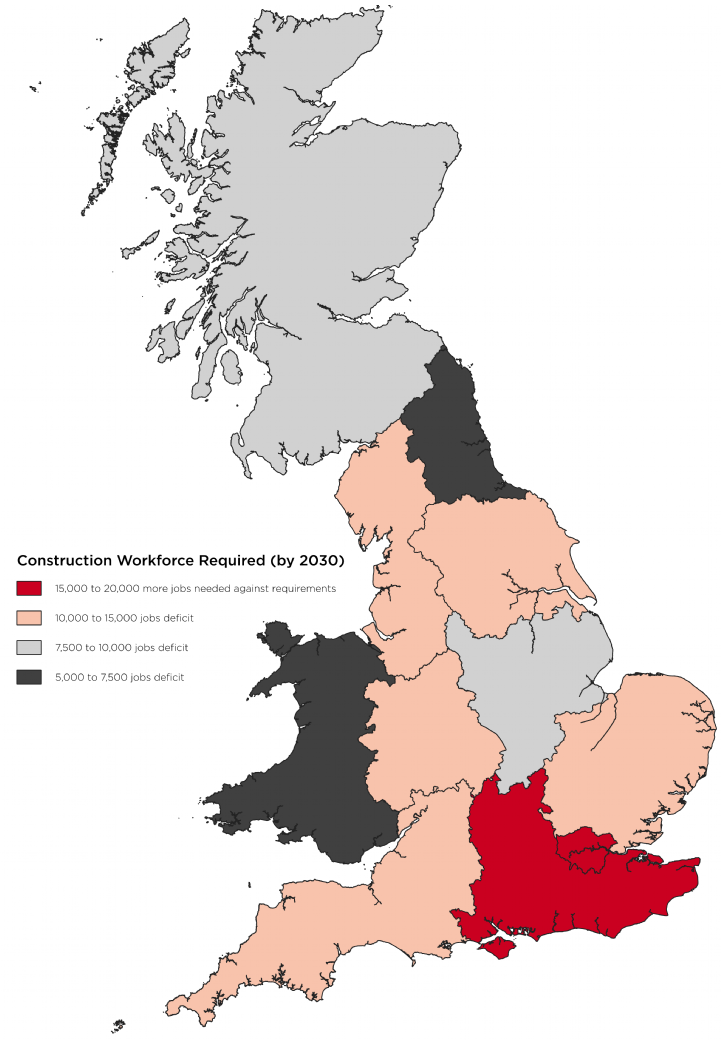
However, the headline figures mask significant regional variations in construction workforce demand. The image below maps the difference in the construction workforce needed against the workforce projections by region to 2030.
The industry's challenge is therefore not simply creating new jobs but replacing the workers it is losing while attracting and retaining a new generation of entrants in the places where they are most needed. The greatest recruitment pressures are expected in the South East and London, but also to a lesser degree in most other regions around England, with housing, infrastructure and energy projects driving demand for engineers, project managers, surveyors and skilled trades.
Government initiatives such as the £600 million construction skills package, the Construction Skills Capacity Fund, the Youth Guarantee and the Jobs Guarantee seek to increase participation in employment, training and skills development. However, ESPs play a critical role in translating these national ambitions into tangible local outcomes.
By securing apprenticeships, work placements, training opportunities and local recruitment commitments through the planning process, ESPs can connect young people and under-represented groups with pathways into work, while helping to address skills shortages and build the workforce required to deliver future development and infrastructure projects.
Forecast construction employment growth vs need (2025-2030)
Source: Savills (2026), CITB, (2026)
From commitments to careers
While ESPs were initially concentrated in London, their use has spread steadily across the country and they are now an increasingly common feature of local planning policy. What began as a tool associated with major regeneration projects is now being used more widely to ensure development delivers lasting economic and social benefits for local communities.
As ESPs have evolved, many authorities have complemented them with dedicated skills initiatives that connect residents with opportunities arising from development. Examples include London's Built Environment Sector Hubs, with £88.6 million of investment announced in July 2026, alongside construction skills programmes in Greater Manchester, the West Midlands and the South West of England.
These initiatives can play an important role in tackling youth unemployment by providing industry placements, employer-led training and apprenticeship pathways. In doing so, they strengthen the link between education and employment while ensuring the benefits of development extend beyond the buildings delivered. Together, ESPs and skills hubs demonstrate how the planning system can support inclusive growth, reduce youth unemployment and help build the workforce needed to deliver future housing, infrastructure and net-zero ambitions.
While these principles are increasingly embedded within national and local initiatives, their value is ultimately demonstrated through delivery on specific development projects.
A recent example of the role ESPs can play in delivering local benefits is Savills Economics' work on the proposed redevelopment of Nottingham Forest Football Club’s City Ground. The project represents a major investment in Greater Nottingham and provided a significant opportunity to generate employment, skills and supply chain benefits alongside the physical redevelopment of the stadium.
Working closely with Rushcliffe Borough Council, Savills prepared an evidence-based ESP that translated the scale of the development into measurable local outcomes. Using recognised National Skills Academy for Construction benchmarks and local labour market evidence, the agreed commitments were designed to be ambitious, proportionate and deliverable.
The resulting package includes up to 150 apprenticeship placements, 14 work experience and T-Level placements, 62 industry-recognised qualifications and 13 construction careers information and guidance events. In addition, approximately 10% of procurement expenditure, equivalent to around £79 million, is expected to support local businesses and SMEs.
Together, these commitments demonstrate how ESPs can convert development activity into measurable employment, skills and supply chain outcomes, illustrating the wider role planning can play in addressing local workforce challenges.
Building a workforce for the future
The challenge facing the UK is not just generating employment, but ensuring people can access emerging opportunities and acquire the skills needed to fill them. ESPs provide a vital mechanism for linking development to skills, training and local labour market opportunities. As investment in housing and infrastructure accelerates, their greatest contribution should be measured not only by the buildings delivered, but by the long-term careers, skills and economic resilience they help create.
Further information
Contact Jonathan Adcock-Shepherd or Vitus Cheung
[1]This includes all London and Greater Manchester authorities, together with authorities within which a Savills Development division office is located.
.jpg)

.jpg)
.jpg)
.jpg)
.jpg)
.jpg)

.jpg)
.jpg)